
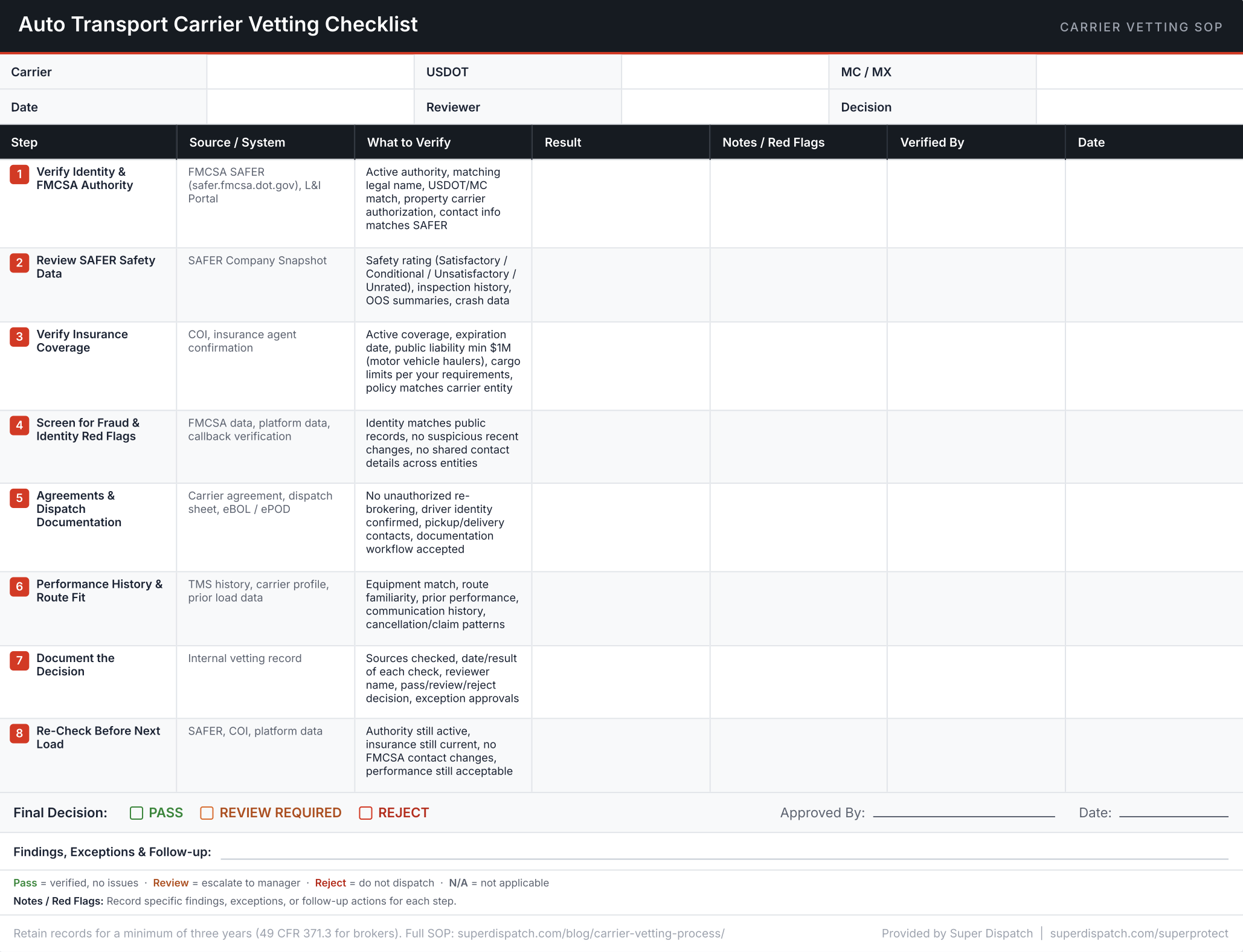
A one-page operational checklist for auto transport shippers and broker operations teams. It covers all eight steps of a carrier vetting workflow: FMCSA authority verification, SAFER safety data, insurance coverage, fraud and identity red flags, agreements and dispatch documentation, performance history, decision documentation, and ongoing re-checks.
Each row names the specific source to check, what to verify, and the most common red flags for that step. Your team fills in the result, notes, and reviewer for every carrier before assigning a vehicle load.
Download the checklist and start running it for every carrier.
Download PDF | Download Word version
What the Checklist Covers
The checklist maps to the eight-step carrier vetting SOP from our Carrier Vetting SOP: How to Vet Auto Transport Carriers Before Assigning a Load guide. Each step becomes one row on the checklist:
- Verify Identity and FMCSA Authority — Confirm active authority, matching legal name, and USDOT/MC number in FMCSA’s SAFER system.
- Review SAFER Safety Data — Check safety rating (Satisfactory, Conditional, Unsatisfactory, or Unrated), inspection history, and crash data.
- Verify Insurance Coverage — Confirm active COI, public liability minimum ($1M for motor vehicle haulers), and cargo coverage per your requirements.
- Screen for Fraud and Identity Red Flags — Cross-check contact details against SAFER, flag recent FMCSA changes, and verify identity through callback.
- Agreements and Dispatch Documentation — Confirm re-brokering restrictions, driver identity, pickup/delivery contacts, and eBOL/ePOD workflow acceptance.
- Performance History and Route Fit — Check equipment match, prior load history, cancellation and claim patterns, and lane familiarity.
- Document the Vetting Decision — Record what was checked, by whom, when, and the pass/review/reject decision.
- Re-Check Before the Next Load — Confirm authority and insurance are still current, no FMCSA changes since last check, and performance is still acceptable.
The full explanation of each step, including regulatory sources, exact URLs, and the reasoning behind each check, is in the complete carrier vetting SOP guide.
How to Use It
When to run it: Run the full checklist for every new carrier lead before their first load as a carrier. For carriers already in your network, re-check authority and insurance status before each assignment. Run the full checklist again whenever FMCSA contact information, ownership, or insurance details change.
Who fills it out: Anyone who assigns carriers to vehicle loads: dispatchers, carrier relations managers, operations leads. The checklist creates a consistent process so vetting decisions don’t vary by team member.
Where the completed record lives: Keep the completed checklist with your carrier file. Brokers are required to retain transaction records for three years under 49 CFR 371.3. Treat the vetting record as part of that documentation. Shippers without a broker obligation should still retain records for at least three years.
The Notes column: Each row comes pre-populated with the most common red flags for that step. Your team doesn’t have to memorize what to watch for. Write specific findings, exceptions, or follow-up actions directly in this column.
The Result column: Mark each step as Pass (verified, no issues), Review (escalate to a manager before proceeding), Reject (do not dispatch), or N/A (not applicable for this carrier type). The final decision at the bottom captures the overall pass/review/reject call with an approval signature.
FAQ
How often should I run the carrier vetting checklist?
Run the full checklist before adding any new carrier to your network. For existing carriers, re-check authority and insurance status before each load assignment. Run the full checklist again whenever a carrier’s FMCSA contact information, ownership, or address changes.
Who should fill out the carrier vetting checklist?
Anyone on your team who assigns carriers to vehicle loads. This includes dispatchers, carrier relations managers, and operations leads. The checklist creates a consistent process across team members so vetting decisions don’t depend on individual memory or judgment.
How long should I keep completed carrier vetting records?
Brokers are required to retain transaction records for three years under 49 CFR 371.3. Keep completed vetting checklists as part of that record. Shippers without a broker obligation should still retain records for at least three years as operational best practice.
See how SuperProtect surfaces carrier risk context directly inside Shipper TMS.