Auto Transport Leads: What They Cost, How They Convert, and When to Buy
Most articles about buying auto transport leads are written by lead vendors. This one isn’t.
Auto transport leads are sales prospects — typically consumers, dealers, or businesses needing a vehicle shipped — that brokers buy from third-party lead providers in either shared (sold to multiple brokers) or exclusive (sold to one) packages. Pricing varies sharply by exclusivity tier — shared leads start around $1.00 to 1.25 per lead on the low end, with exclusive or call-transferred leads costing several times more in exchange for materially higher close rates.
Table of Contents
-
- What auto transport leads are and how the market actually works
- What auto transport leads cost: shared, exclusive, and what’s in between
- The major auto transport lead providers (and how to evaluate them)
- Speed to lead: the single biggest factor in whether you close
- The ROI math behind buying auto transport leads
- TCPA and consent: what brokers buying leads need to know in 2026
- Owned lead channels: the play that compounds
- What the broader auto transport market means for your lead strategy in 2026
- Get a Free Broker’s Edge Playbook
What auto transport leads are and how the market actually works
In broker-speak, an “auto transport lead” is a single sales prospect: a name, contact info, and a quote request to ship one or more vehicles. Most leads are generated by SEO-optimized comparison and quote-request sites operated by lead providers. A consumer fills out a quote form thinking they’ll get a few prices; in real time, that submission is sold to up to 10 brokers simultaneously, and they all start calling and emailing within minutes.
That distribution mechanic drives almost everything else in this guide as most auto transport broker leads are shared with a lot of brokers. It’s why pricing tracks exclusivity, why response time matters more than almost anything else, and why broker margin on a purchased shared lead is much thinner than the lead provider sales pages suggest.
What auto transport leads cost: shared, exclusive, and what’s in between

The lead market in 2025–2026 spans a wide pricing range, driven mostly by exclusivity tier and intent quality rather than absolute lead “quality.”
Shared leads
Shared leads sit at the floor of the market. iMover Leads guarantees a maximum cost of $1.25 per lead, with leads shared with up to 9 other brokers. Auto Transport Broker Leads charges $2.75 per lead when shared with up to 10 brokers, rising to $5 per lead when shared with up to 4 others. Vendor-published conversion rates for shared leads typically fall in the 5% to 9% range.
The math of shared leads only works if you have the operational speed to be the first or second broker to actually reach the consumer. We’ll come back to that.
Exclusive and call-transferred leads
Exclusive leads, sold to only one broker and often delivered via live call-transfer, command a premium because they eliminate the “speed-to-lead” race. For an auto broker, this means skipping the “chase” and moving directly to the deal. However, exclusivity doesn’t always mean better; whether that premium makes sense depends on your specific commission margins, your efficiency with shared leads, and the “lane mix” of the inventory you are moving.
The major auto transport lead providers (and how to evaluate them)
The active U.S. auto transport lead provider landscape includes iMover Leads, Auto Transport Broker Leads, Live Transport Leads, Compare the Carrier, and Cart Transport Leads, among others. Each offers different package structures, pricing, and integrations with broker software.
We’re not going to rank them. The “best auto transport leads” SERP is dominated by content published by the lead providers themselves, which makes affiliate-style rankings structurally biased. What matters more is having a framework you can apply to any provider. For a broader take on how to think about the platforms brokers depend on, the auto transport platform buyer’s guide is a useful companion read.
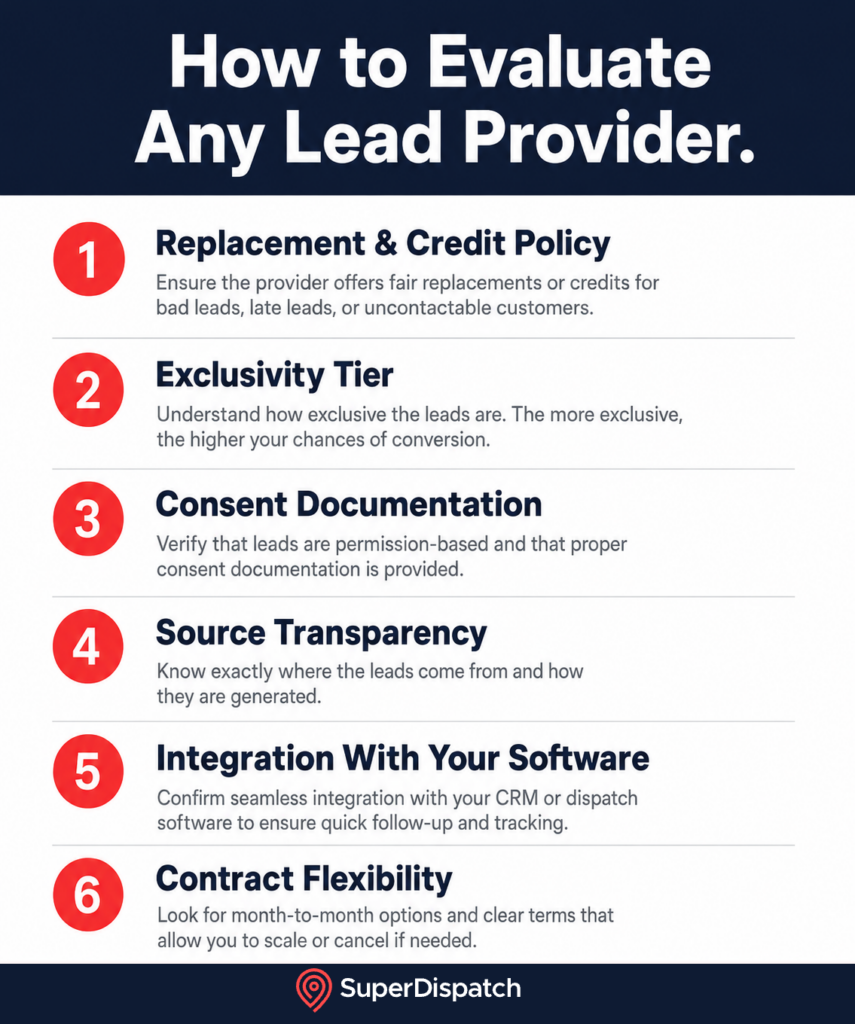
How to evaluate any lead provider
When you’re vetting a new auto transport lead provider, or auditing one you already pay, work through this checklist:
- Replacement and credit policy. What happens with bogus contacts, duplicates, or tire-kickers? A real credit policy signals confidence in their own quality.
- Exclusivity tier. How many brokers receive the same lead, and is the tier enforced through random rotation or are you stuck competing against the same brokers every time?
- Consent documentation. Ask for proof of consent — TrustedForm or Jornaya certificates that name your brokerage specifically. This matters more in 2026 than it used to.
- Source transparency. Where do leads come from — owned organic-traffic sites, partner networks, paid media? Owned organic sources tend to produce higher-intent leads.
- Integration with your software. Does the provider drop leads directly into your CRM via API or parser, or do you re-key them by hand?
- Contract flexibility. Month-to-month with no minimums and the ability to pause should be table stakes.
Speed to lead: the single biggest factor in whether you close
If there’s one thing in this guide worth taping to a dispatcher’s monitor, it’s this section.
Dr. James Oldroyd’s MIT Lead Response Management Study analyzed over 15,000 web-generated leads and found that the odds of contacting a lead within 5 minutes versus 30 minutes were up to 100 times higher, and the odds of qualifying the lead were 21 times higher. Harvard Business Review reported that, in a study of 1.25 million sales leads, firms that responded within an hour were nearly seven times as likely to qualify a lead as those that waited even one additional hour.
In a market where every shared lead goes to up to 10 brokers, the broker who calls in 60 seconds usually wins the conversation. The broker who calls in 30 minutes is usually too late.
The catch: only 0.1% of inbound B2B leads get engaged within the first 5 minutes — with conversion rates dropping 8x once that 5-minute window closes. That gap is opportunity. A broker who builds the operational infrastructure to actually hit a sub-5-minute response — automated SMS confirmation, mobile push notifications, a dispatcher rotation that covers business hours, and an essential CRM for auto transport brokers that surfaces new leads at the top of the queue — has a structural advantage over the entire field.
If you’re spending money on leads but your average response time is measured in hours, fix the response time before you spend another dollar. The math says it’s the higher-leverage move.
The ROI math behind buying auto transport leads
Here’s a worked example using realistic broker numbers:
- 1,000 shared leads at $2 per lead = $2,000 in lead spend
- 5% close rate (more conservative than the 8.2% figure one lead vendor advertises) = 50 booked shipments
- $150 average broker commission per shipment = $7,500 gross revenue
- Less lead spend = $5,500 contribution before operating cost
That’s not a 200% ROI claim. It’s a margin number that has to clear dispatcher labor, software, marketing, and the carrying cost of the $75,000 broker bond before you book anything.
Now run the same math with a 7% close rate driven by sub-5-minute response time:
- 70 booked shipments × $150 = $10,500
- Less $2,000 lead spend = $8,500 contribution
Two percentage points of close rate adds $3,000 on the same lead spend. That’s why operational improvements outperform spending more on more leads.
For context on shipment economics: single-VIN load prices on Super Dispatch rose as much as 10% year over year by the second half of 2025, reflecting broader auto transport pricing trends driven by longer average distances and corridor-specific demand surges. Broker margin is a fraction of total move price, which is why close rate matters so much.
If you’re looking for more insights on the cost of moves for a specific lane, we have a tool that can run that for you. It uses data from moves on the Super Dispatch platform to price with certainty. You can try it for free here.
What to actually track to know if leads are working
Stop tracking cost per lead in isolation. Track:
- Cost per booked shipment (lead spend ÷ booked shipments)
- Close rate by lead source (so you know which providers actually work for your operation)
- Time-to-close (first contact to dispatch)
- Customer lifetime value (repeat shipments, referrals, multi-VIN expansion)
If you’re not measuring these, you’re flying blind.
TCPA and consent: what brokers buying leads need to know in 2026

The regulatory landscape changed materially in 2025, and most older content gets it wrong.
The FCC’s “one-to-one consent” rule, which would have required lead generators to obtain individual consent for each seller, was scheduled to take effect on January 27, 2025. On January 24, 2025, the U.S. Court of Appeals for the Eleventh Circuit vacated the rule entirely, holding that the FCC exceeded its statutory authority under the TCPA. In April 2025, the FCC stated it would not challenge the ruling. The rule that lead generators feared is not in effect.
That doesn’t mean compliance is irrelevant. Separate FCC TCPA rules took effect on April 11, 2025 governing consumer revocation of consent: brokers cannot restrict how a consumer revokes consent and must honor revocation requests within 10 business days.
And although the federal one-to-one mandate was struck down, most compliance attorneys still recommend treating it as best practice. Bulk consent, where a single click consents to dozens of “marketing partners”, remains a high-litigation-risk activity.
Practical takeaways for brokers buying leads:
- Ask any provider for consent documentation that names your brokerage specifically.
- Audit the disclosure language on any webform you operate.
- Build a clean revocation workflow that honors opt-outs across phone, text, and email within the 10-day window.
- Talk to your own counsel before you build a compliance program. None of the above is legal advice.
Owned lead channels: the play that compounds
Purchased leads are a tool, not a strategy. The brokers who build durable books of business invest in owned channels that compound over time.
The plays worth building:
- Referral programs. Auto transport is a service most customers use rarely, but they know other people who need it. A program that rewards both the referrer and the new customer turns one happy customer into multiple bookings.
- Repeat customer reactivation. Snowbirds, dealers with regular auction trips, fleets with rotating equipment — these customers ship more than once. A simple email or SMS sequence that resurfaces their old quote at the right time of year converts at rates purchased leads can’t touch.
- Organic SEO and content. Targeting geographic and operational queries that purchased-lead funnels don’t capture (specific lane pages, specialty vehicle pages, dealer-focused content) builds traffic that doesn’t depend on a vendor’s pricing. There’s a deeper playbook in our piece on marketing tips for auto transport brokers.
- Google Business Profile. Local intent matters. A well-optimized GBP with current photos, accurate service area, and active review collection captures intent that lead providers don’t see.
- Adjacent partnerships. Auctions, dealerships, relocation companies, and corporate HR teams all generate vehicle shipping demand. Direct relationships produce higher-margin, higher-loyalty bookings than any purchased channel — and the same operational discipline that goes into building carrier relationships pays off on the customer side too.
Owned channels take longer to ramp than buying a lead package. They also keep paying back for years.
What the broader auto transport market means for your lead strategy in 2026
If you’re spending real money on lead acquisition, it helps to know what’s happening in the market you’re acquiring into.
According to Super Dispatch’s auto transport industry report, nearly 10 million vehicles moved through the platform in 2025, a record year for the platform. Carriers earned more than $5 billion in revenue through Super Dispatch in 2025. Volume is growing, average shipment value is climbing, and the demand brokers serve isn’t going anywhere.
Three platform-level trends matter most for your lead strategy:
- Regional demand is shifting. The Northeast surged 27% in delivery volume, with New Jersey leading at +48%. The West grew 19%, led by Arizona and California. Brokers who concentrate lead acquisition in these regions are buying into stronger tailwinds.
- Automated load matching is dominating booking. Load Requests, automated load matching, grew 73% overall on Super Dispatch in 2025, climbing from 15% of all orders in January to 21% by December.The same shift is coming for broker lead handling. Operations that still rely on manual lead triage are competing against operations that don’t.
- Reputation now affects close rate more than ever. Double brokering and damage complaints grew. Customers research broker reviews before they pick up the phone. A purchased lead doesn’t convert if the prospect Googles you and finds three damage complaints.
The market is bigger and faster than it was when most “buying auto transport leads” content was written. The brokers who win in 2026 are the ones whose operational systems match the speed of the market.
The bottom line
Buying auto transport leads is a tool, not a strategy. Pricing varies widely by exclusivity tier, conversion rates depend more on your operational speed than on the lead provider, and the brokers who actually make the math work pair purchased leads with owned channels that compound over time.
The fastest single improvement most brokers can make is sub-5-minute response time. The next is honest ROI tracking — cost per booked shipment, not cost per lead. After that, build the owned channels, get TCPA compliance current, and use the broader market data to point your lead spend at growing regions.
If this is the kind of operational thinking you want more of, the Broker’s Edge assembles the guidance you need to build a working playbook.